
Sea of Love (1989): The Single Life Is Murder
Despite its reputation as a police procedural, Harold Becker’s Sea of Love is really about navigating the dating scene as a middle-aged person.

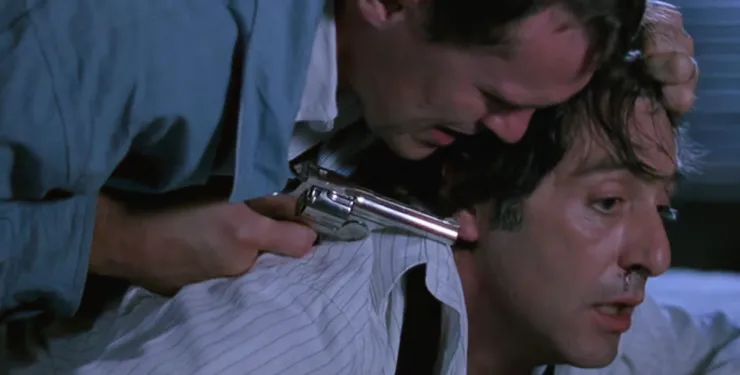
Harold Becker’s Sea of Love opens with essential Film Noir stuff: an aerial shot of the New York City skyline, a montage of Manhattan’s busy nighttime streets, the languid wail of a saxophone. Watch this sequence closely and you’ll notice something else. The storefronts that populate the footage are either singles bars or “date night” style restaurants, and several of the shots feature female prostitutes.
In other words, while the casual viewer may dismiss Sea of Love‘s opening moments as stylized filler, these scenes actually provide the context by which we can interpret the film as a whole: dating.
The fake New York Yankees charity brunch used by Keller (Pacino) and his colleagues to round up fugitives is set up like a blind date, or perhaps a “speed dating” event.
The prologue-style murder scene, soundtrack courtesy of “Sea of Love” by Phil Phillips, is also presented in the context of a date. This one short scene opens the film’s primary narrative loop while also establishing a pneumatic device that later functions as a clue.
Lastly, Keller’s late night phone call to his ex-wife resembles a pathetic booty call, the 1980’s equivalent of a “drunk text.”
In just five minutes of expert visual storytelling, Becker shows us everything we need to know about this film: genre, setting, structure, character and plot—with almost zero dialogue. This is how to open a movie.
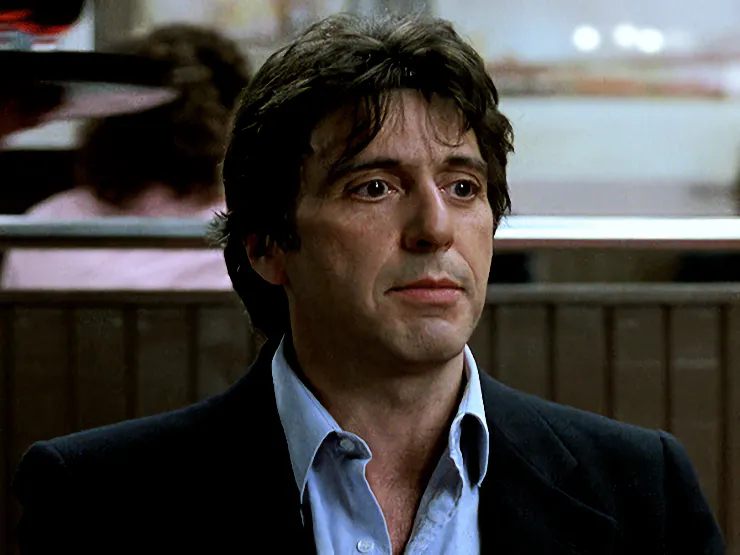
Sea of Love benefits from a committed, balanced performance by an Al Pacino still clearly in his prime. With only one clownish outburst (“I’m everybody’s daddy!”) Pacino’s cliché-free portrayal of Detective Frank Keller previews his performances in Michael Mann’s 1995 masterpiece Heat and Christopher Nolan’s underrated Insomnia (2002).
Like those aforementioned roles, Pacino’s Frank Keller is clever, successful, handsome and brave. And yet, he is not a complete person. Keller’s job dominates every aspect of his life. Without his career, he’s nothing. And while being a cop is the only thing that seems to make his life worthwhile, ironically, it will also be the thing that kills him in the end.
Despite the early 1990‘s context of the film, Keller possesses all the hallmarks of the classic hardboiled detective: cynical, violent, drunk, exhausted, divorced, considering retirement, and firmly middle class. We even learn that Keller’s wife has left him for his former partner (Richard Jenkins).
Beyond seeding the plot, Sea of Love‘s first act also establishes Keller’s vulnerability. Drunk. Lonely. Cuckolded by a co-worker. Without showing us these qualities at the outset, his eventual tryst with a potential murderer would seem completely contrived. In other words, Frank Keller doesn’t fall from grace. When Sea of Love begins, he’s already falling.
Helen Cruger (Ellen Barkin) makes her first appearance at the forty-three minute mark. Before she even opens her mouth, Cruger’s red leather jacket and matching red lipstick telegraphs everything we need to know about her character.
The best way to describe Barkin’s performance is that she steals every scene in which she appears. I won’t attempt to analyze exactly why her on-screen presence is so alluring, it just is. As they say, “the camera loves her,” and I challenge anyone who’s actually watched Sea of Love to tell me otherwise.
Ellen Barkin’s Helen Cruger is clearly who Sharon Stone was imitating during her string of almost identical/very horny erotic thrillers that began with Total Recall (1990), peaked with Basic Instinct (1992), and ended (mercifully) with the ridiculous Diabolique (1996).
Bringing things back to the film in question, Sea of Love‘s second act is concerned with mirroring, seeding doubt, and building up erotic tension. With these three elements in mind, consider Barkin’s performance.
Helen Cruger is every bit as cold, distant and transactional as Frank Keller. When she sits down at their blind date, she sees right through Keller’s ruse. It’s not because she figures he’s a cop, it’s because she can spot a liar from a mile away. Just like him.
Cruger flips the script on Keller at their second rendez-vous. No longer party to the police investigation, the entire dynamic plays out on her terms. And while we still suspect that she’s the killer, as their date goes on, we become less and less sure of ourselves.
Part of our indecision comes down to Becker’s directorial slight of hand, but Barkin gets the rest of the credit. She seems to soften herself during this part of the film, forcing us (and Keller) to re-assess our initial position.
Lastly, with regards to erotic tension, Barkin does her best with the material at her disposal. Does Frank Keller seem too old for her? Yes. Does it seem like his breath would really stink? Yes. Does he need to buy new underpants? Yes. But I don’t think Helen Cruger would smell too great after selling shoes all day either.
In short, the grossness of strangers is a key source of Sea of Love‘s erotic tension. One night stands can result in lots of different outcomes, particularly in cities like New York. In a best case scenario, a legitimate relationship may blossom. In a worst case scenario, you might get murdered.
The median outcome is probably that you’ll never see the other person again. Both parties simply vanish into the anonymity that a city of 24 million people can so easily provide. It’s this mix of risk, novelty and transience that Helen Cruger gets off on. She’s out there looking for some strange, and with Keller, she finds it—giant underpants and all.
Barkin somehow brings these proclivities to life without resorting to caricature, without the slightest hint of irony or cliché.

Beyond its two brief murder scenes, Frank Keller is Sea of Love‘s only point of view character. Never one step ahead, or a moment behind, we navigate the world of the film as he does.
Stylistically, this point of view is synonymous with the first person narration that defines the Classic Noir and Hardboiled Detective novels of the 1930’s and 40’s.
In the context of literary Modernism, a first person point of view also provides an opportunity to employ an unreliable narrator. Imagine if Frank had turned out to be the killer?!
Sadly, Sea of Love adheres to a more conservative narrative paradigm. But at least it does so in a competent, consistent manner. At no point do we question the film’s internal logic. Most importantly, at no point do we “head hop” from one character’s point of view to another.
Broadly speaking, many aspects of Sea of Love resemble the dating scene. The New York Yankees breakfast ruse is set up like a speed dating event. Keller’s evidence collection operation in the restaurant is literally, and figuratively, a series of blind dates. When Keller snoops around Helen’s house, or shows up at her work, or withholds information that may adversely affect her attraction to him—is he performing the duties of a cop, or behaving like any potential sexual partner?
The inherent similarities between searching for a mate and searching for a murderer are therefore baked into the film’s overall structure:
- First date conversations vs. Police interrogations
- Blind dates vs. Stake outs
- Romantic fixation vs. Surveilling a suspect
- Heartbreak vs. Murder
Sea of Love gently asks us to compare these elements. And while I do find the concept interesting, it’s a shame the film didn’t express these uncomfortable similarities more overtly.
Beyond its major beats, Sea of Love also sways back and forth between its representation of Helen’s culpability. At times, we are absolutely sure she’s the killer, only to change our minds a few scenes later. Beyond the obvious entertainment value, this oscillating format mimics waves in the ocean. Is she or isn’t she? Does she or doesn’t she? Will she or won’t she? We bob up and down in the sea (of love) as our theories toggle back and forth.
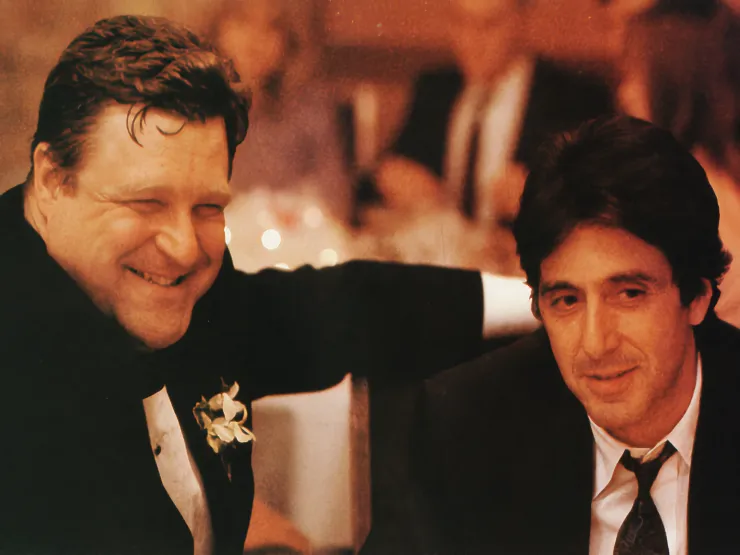
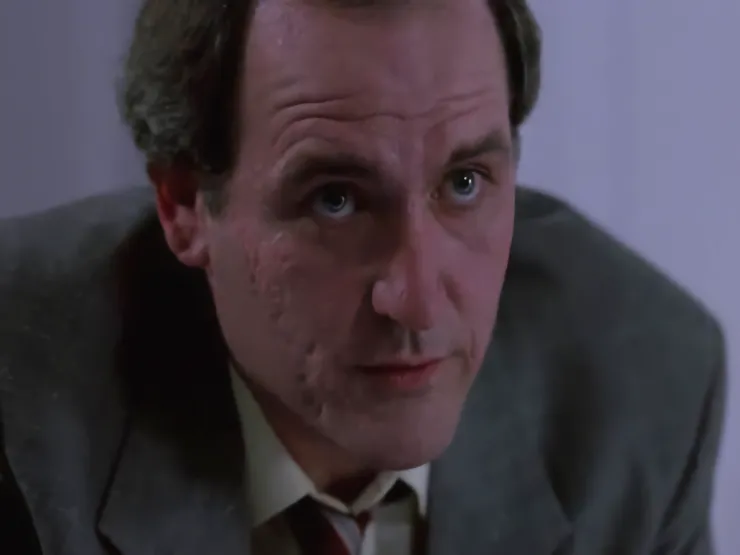
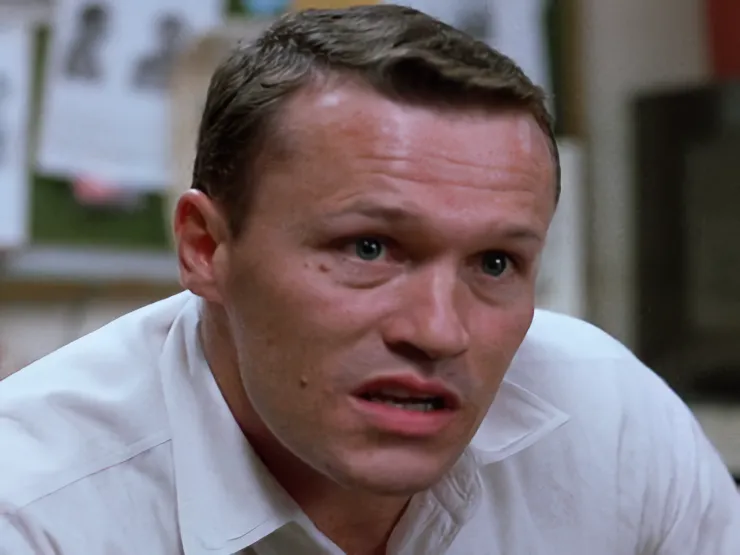
Many pundits have rightly criticized Sea of Love‘s ending as unfair to the audience. I totally agree with this position. There are simply no clues linking Helen’s husband Terry (Michael Rooker) to the crime, unless we are expected to read his mind during the interview with Keller and Touhey (John Goodman). Beyond robbing us of the opportunity to solve the case or even formulate a cogent theory, this lazy ending simply leaves us with a bad taste in our incredulous mouths.
It wouldn’t have been that difficult to give the audience a fighting chance. When Keller’s rummaging through Helen’s purse, he could have found a clue that suggests her husband is a repairman. There was also ample time to plant a notable object in her house that savvy viewers may have noticed in the background. Lastly, when we encounter Terry Cruger, first at his place of business and next at the police station, giving us a nickname or a moniker that obliquely links him to Helen would have been a simple way to solve this movie’s problem.
Beyond disrespecting the audience, the ending is also a missed opportunity from an artistic standpoint. Sea of Love is a working class story: a pair of middle-aged singles, neither of them rich or famous, going about their lives in Manhattan. With so few New York City films about everyday people, Sea of Love could have been a discussion about social class and economic inequality. Instead, the killer turns out to be just another “creepy air conditioning repairman.”
If the killer had been a police officer, Sea of Love would have been a film about justice.
If the killer had been a billionaire, Sea of Love would have been a film about power.
But when the killer is revealed to be a jealous blue collar worker, any opportunity for meaningful social commentary goes out the window along with his flailing body.

Despite its reputation as a police procedural, Sea of Love is really about navigating the dating scene as a middle-aged person.
Heartbreak is likened to murder. The search for a sexual partner is likened to a police investigation. Embarking on a monogamous relationship is likened to solving a case.
Despite these bold transgressive metaphors, enjoying Sea of Love does not hinge on engaging with the movie’s subtext. The film’s Hollywood star power, narrative drive, Film Noir stylings and erotic interludes are more than enough to keep casual viewers entertained throughout its one hundred and fourteen minute run-time.
That’s all for now.
Thanks for reading.
See you in the movies,
Tod.
© Copyright Debtford Press 2026. All rights reserved.