
The Long Goodbye (1973): Post-Marlowe Noir
Robert Altman’s 'The Long Goodbye' is more than just a detective story. This film has something to say about the 1970’s.


My favourite thing about The Long Goodbye is its absurdly mellow opening sequence. More of a prologue than part of act one, a short blast of Hooray for Hollywood tells us we’re in California long before the camera settles on Detective Philip Marlowe (Elliott Gould).
We see a fully dressed man, asleep with the lights on, in a ratty unmade bed that also contains a dirty dinner plate and a used napkin.
While opening a film in this manner may seem peculiar to some, Marlowe’s seemingly mundane late night routine is actually a brilliant expository device. This subtle tour of his apartment provides clues about Marlowe’s socio-economic status, conveys the story’s time and place, and gives us a provocative glimpse of his free-spirited neo-hippie female neighbours.
These disparate elements, packaged neatly as a quest for cat food, tells us Robert Altman’s The Long Goodbye is more than just a detective story. This is a film with something to say about the 1970’s.
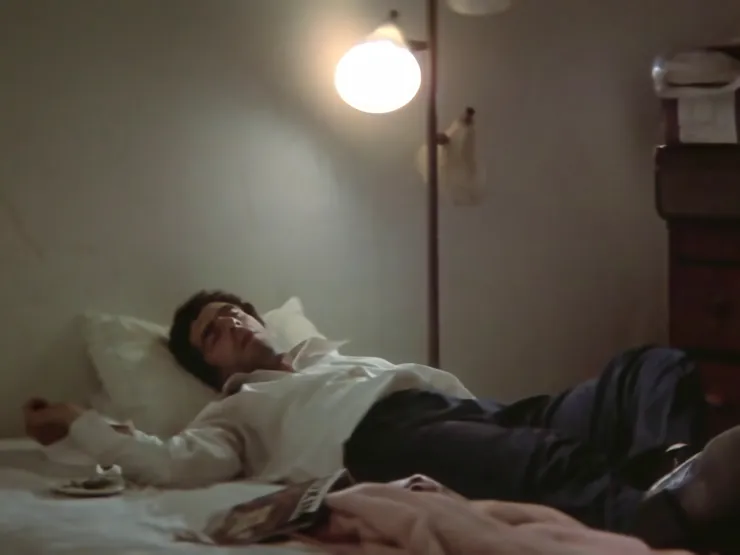
Much has been written about the so-called “cat food scene,” but what some have failed to note is that Marlowe’s mumbling, bumbling musings are a call-back to the radio dramas of the 1940’s, in which Marlowe often talked to himself as he navigated from one sequence to the next.
Tricking his pet cat by hiding the generic brand inside a more expensive can is also a perfect metaphor. Not only does this bait and switch foreshadow the movie’s plot, it also represents the nature of Marlowe’s job. As a private detective, he almost always begins with one case and ends up with another.
As a plot device, Marlowe’s quest for cat food gets him out of the house so that Terry Lennox (Jim Bouton) can show up unannounced. Ultimately though, his jaunt to the all-night supermarket is just one of many anachronistic leanings throughout the film:
- Not only is he constantly smoking, Marlowe lights his cigarettes with a match.
- He doesn’t have a proper office. Instead, he takes his calls at the local bar, a common trope in many mid-century detective stories.
- In contrast to the casual fashions of the 1970’s, Marlowe wears a suit and tie for the entire movie: the grocery store, the bar, jail, the beach, even three short to trips to Mexico.
- Perhaps most strikingly, Marlowe’s automobile is an ostentatious relic of the 1940’s—just like him.
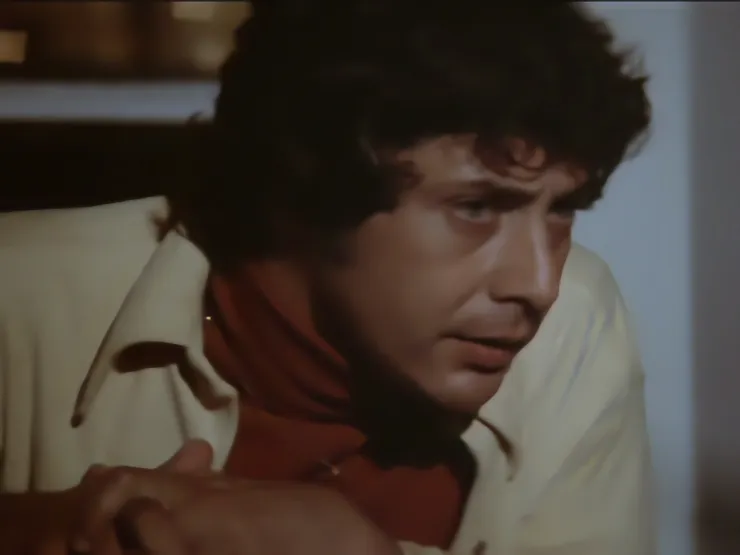
The first act truly begins when the cops show up at Marlowe’s apartment and place him under arrest. This scene foreshadows a similar instance later in the film when gangster Marty Augustine (Mark Rydell) shows up in search of stolen cash.
The scenes of Marlowe being processed at the station serves two functions: one is as a plausible vehicle for the expository dialogue that establishes the film’s plot, the other is a showcase for Gould’s considerable talent. His cynical back and forth with the police detectives is a suitable, well executed homage to Chandler’s brilliant dialogue in the original Philip Marlowe novels.
While some viewers may complain these fifteen minutes at the station move too slowly, I would argue that many of today’s films sacrifice plausible exposition in favour of ridiculous info dumps, often delivered via contrived, unnatural conversations that seem completely alien to the rest of the film.
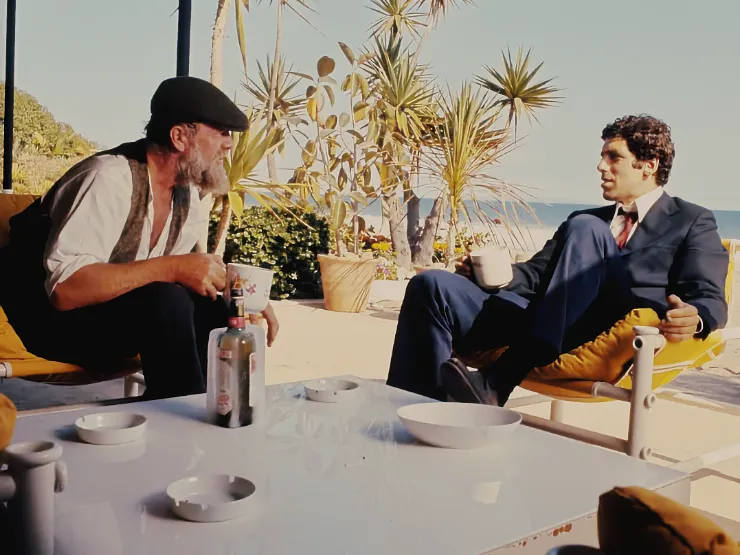
The Long Goodbye’s drowning sequence, in which a blurry Roger Wade stumbles down the beach in the background of another shot, is among the film’s most striking.
Marlowe and Eileen struggle in the surf, ultimately failing to reach Wade before he drowns. Roger Wade’s death happens off camera, in opaque waters, with the roar of an indifferent ocean providing a dramatic soundtrack.
Here, we are reminded of Raymond Chandler’s clever use of names. Roger Wade, who mentions suicide upon returning from the clinic, ends his life by slowly wading out into the ocean.
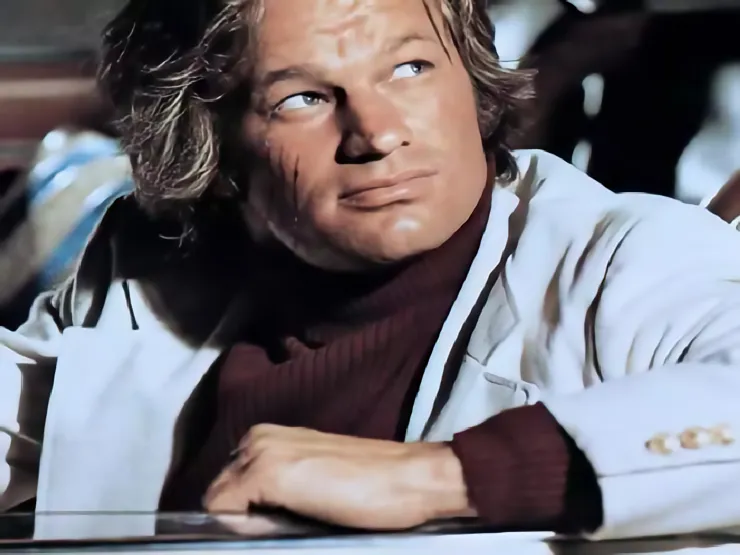
Although brief, Marlowe’s act two trip to Mexico is essential to the plot, setting up both the twist and the epilogue, and confirming that he indeed does more than loaf around: this man does some good detective work as well.
Terry Lennox is The Long Goodbye’s “MacGuffin” appearing briefly at the beginning and the end, the object of the search, but never the subject. When Lennox re-emerges in the film’s conclusion, he gives The Long Goodbye a decisive ending, without sacrificing the continuity that is so essential to the genre. Although the film comes to a close, Marlowe does not. He strolls away from Mexico the same way he strolled in: tired, broke, alone—but somehow—always getting by.
Introduced in The Long Goodbye’s opening scene, the plot gradually gains complexity, peaking around the one hour mark when we learn that gangster Marty Augustine is in fact connected to Roger and Eileen Wade. This particular thread is just one of screenwriter Leigh Brackett’s clever additions to the script. Here, she creates additional narrative drive during the prolonged second act, while still avoiding the alcohol induced convolution that plagued the Chandler novel. Crucially, Brackett keeps the clue to their connection simple and understated: fifty-thousand dollars.
Although many aspects of the novel were altered or omitted, Brackett wisely didn’t mess with the The Long Goodbye‘s most important characteristics. The film retains the novel’s feel and spirit, playing out in the third person limited point of view. Marlowe appears in every scene. Although we don’t watch the film strictly through his eyes, we nonetheless interpret it from his perspective. We remain in sync with Marlowe as he navigates his world, never one step behind like a traditional whodunnit, never slightly ahead like a typical thriller.
First person point of view is notoriously difficult to execute on screen, primarily because film is a visual medium that gets boring if you can’t watch the protagonist react to his or her surroundings. Screenwriters often resort to cheesy gimmicks like found footage or journal entries to circumvent these issues but still ensure sure their first person scripts are adequately “literary.”
Third person limited conveys all the benefits of first person point of view, but with fewer drawbacks. Yes, we sacrifice a degree of the interiority conveyed by novels. But at least some of what is lost can be recouped by using internal monologues, or in this case, Marlowe mumbling to himself as he saunters around town.
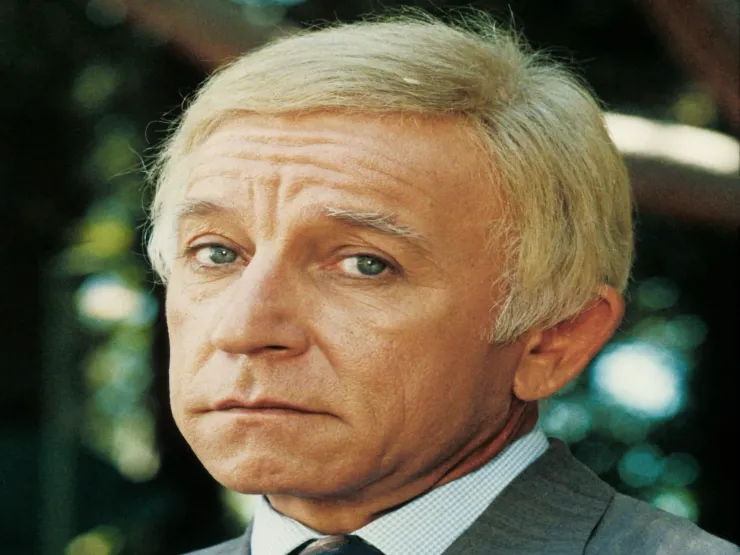
In terms of setting, seedy Los Angeles is juxtaposed with “Malibu Colony,” a gated beachside community. Hippies, gangsters and working-class bums aren’t welcome there. But those who straddle both worlds, guys like Marlowe, Lennox, Augustine and Verringer, can still gain access. Malibu Colony is thus a metaphor for the transactional nature of 1970’s California, where looks or money or power could open doors that would otherwise stay closed.
But the “world of the film” describes more than just the physical locations where a given story unfolds. Fictional worlds, like literary genres, require rules, conventions, and a plausible internal logic in order to successfully inhabit our imaginations.
And that’s exactly where The Long Goodbye presented challenges. Not only is Detective Philip Marlowe inevitably associated with the 1940’s, the character will also be forever tied to Humphrey Bogart, an actor who is practically synonymous with the original Film Noir period. Would audiences have responded well to an earnest Film Noir throw-back less than twenty years after they had fallen out of fashion? Of course not.
Enter the Neo-Noir, a slickly modernized rendition of the classic Film Noir style—but free of its clichés and limitations. This is a world where private medical clinics double as extortion rings. Where psychopathic gangsters also take an interest in their physical fitness. Where you can shoot and kill a man in Mexico because on paper, he’s already dead.
And while The Long Goodbye knows that it’s a film, it doesn’t trivialize the importance (or existence) of films in general. In other words, it acknowledges the past, but never with a sarcastic wink. This is not some shitty Mike Myers movie. This is satire with a lower-case ‘s’ that seeks to answer a simple but fascinating question: What if Philip Marlowe was a private detective in 1970’s Los Angeles?
Don’t shrug this off. It’s the same type of question Christopher Nolan must have asked himself before embarking on his Batman trilogy, or Denis Villeneuve may have posed before agreeing to direct the Blade Runner sequel, or attempt to re-make Frank Herbert’s Dune.
Good adaptations are translations. Great adaptations are brave, compelling re-interpretations. Bad adaptations are nothing more than lazy karaoke. Want some proof? Check out Liam Neeson in the unfortunate Marlowe (2023), where Neeson’s fedora achieves the movie’s most convincing acting performance.
Without Altman’s vision and Brackett’s writing, The Long Goodbye could have easily defaulted into Neeson territory too.
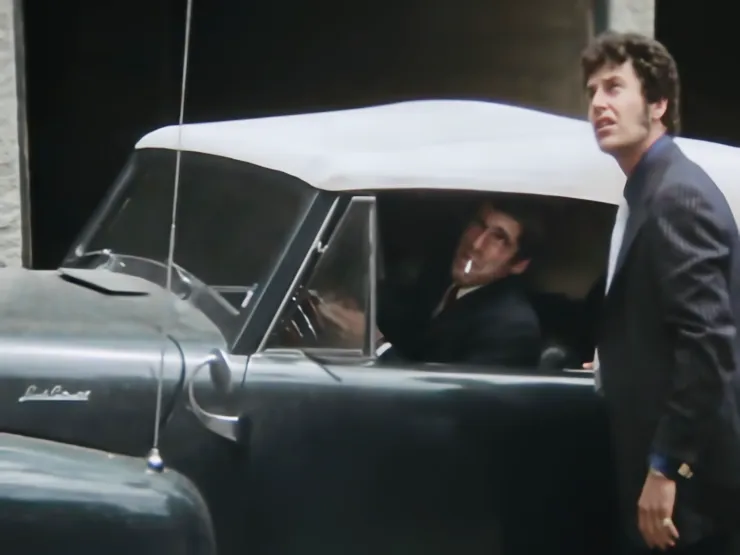
Somewhat famously, The Long Goodbye is soundtracked by a single song. Written by John Williams (yes, ‘that’ John Williams) and Johnny Mercer, “The Long Goodbye” transforms into many different renditions and arrangements, repeating throughout the duration of the film: with or without lyrics, instrumental jazz, stripped-down folk, exuberantly played by a Mariachi band, even poorly crooned by Marty Augustine as he trims his fingernails with a giant pair of scissors. This is not a gimmick. This is an artistic choice. Just as Marlowe is transported from the 1940’s into (then) contemporary Los Angeles, the movie’s theme song is also transportable to any musical genre, to any era or cultural milieu. It posits the idea that just as there are many versions of the song, there are also many Marlowes, maybe even one for every cinematic era. Besides, Marlowe has always been a solitary man. Why shouldn’t his story have a single song?
But The Long Goodbye’s musical proclivities also represent its many post-modern leanings. In a literary context, post-modernism suggests that ANY story contains EVERY story. Perhaps more relevant is the post-modern suggestion that every possible story has already been told, and that the only thing an artist can do is re-arrange, re-interpret, and re-contextualize the existing canon. In short, post-modernism tells us that the story is not “the main thing:” its the way the story’s told that truly gives it meaning. The Long Goodbye’s music represents this maxim perfectly.
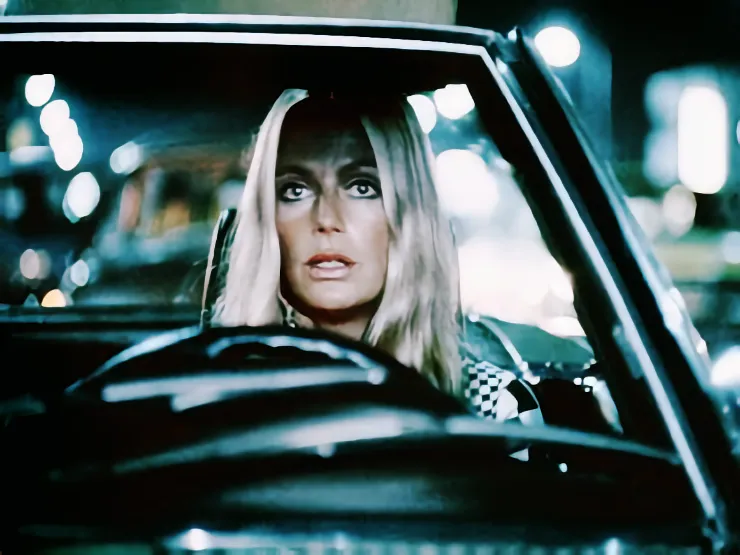
The literary Marlowe is not portrayed as wealthy or particularly well-mannered, but his general demeanour and his former job in the district attorney’s office still convey a sense of discipline, order and respectability.
In short, Raymond Chandler’s Marlowe is a humble gentleman, with modest hopes and aspirations, who also likes to drink. So perhaps it’s not surprising that initially, Altman’s Marlowe was so disliked by audiences and critics. Who the hell’s this mumbling curly-haired dimwit with dirty dishes in his bed?
The problem is that when we think of cinematic Marlowes, inevitably, we think of Humphrey Bogart. Why is this a problem? Because Bogart also played Sam Spade in The Maltese Falcon (1941). The truth is that beyond their jobs, Sam Spade and Philip Marlowe are nothing alike. Audiences tend to conflate these characters, which pollutes their cinematic expectations. I think this phenomenon was definitely at play when Altman’s film was first released.
When you think of Marlowe, do you think of Robert Mitchum? Perhaps you should. Mitchum starred as Philip Marlowe in The Big Sleep (1975) and Farewell, My Lovely (1978), both of which were bad and boring.
People also forget that Philip Marlowe was a hit on 1940’s radio, with the likes of Dick Powell, Gerald Mohr, Robert Montgomery and Van Hefling each taking turns as Marlowe on various shows throughout the decade.
My point is that there is no “perfect” Marlowe. Like all iconic characters, he can be re-invented to suit any historical or cultural era. Sure, go ahead and choose your favorite, but don’t shit on a creative rendition because it doesn’t stick exactly to the text.
Personally, I like the radio Marlowes the best. I love the novels and their punchy first-person narrative, and classic radio brings the Chandler voice to life in a way that movies mostly don’t.
But if I have to choose my favourite movie Marlowe, I’m choosing Elliott Gould. He’s cynical, but in a smart way, not a grumpy grandpa way. He doesn’t inflict violence, but he also never flinches when the threat of violence looms. He’s not a sloppy drunk, but he looks like one. And thus he navigates his sleazy L.A. world more fluidly than Chandler’s Marlowe ever could.
Most importantly, although the other Marlowes exhibit standard hard-boiled language and demeanor, only Elliott Gould’s Marlowe truly qualifies as a Film Noir anti-hero.
Unlike those other films, Gould’s Marlowe plays both sides of the law. His disdain for the incompetent police is almost equal to his dislike of two-bit crooks. He doesn’t think much of his clients either. He also shoots a guy in Mexico! Crucially, Gould’s Marlowe doesn’t pull the trigger for the money. He doesn’t even do it for revenge. He does it for the truth. When he kills Terry Lennox, he does it for Sylvia. Gould’s Marlowe is a good guy who does bad things for a good reason. In The Long Goodbye’s seedy world of liars, thieves, whores and charlatans, he’s the best of the worst.
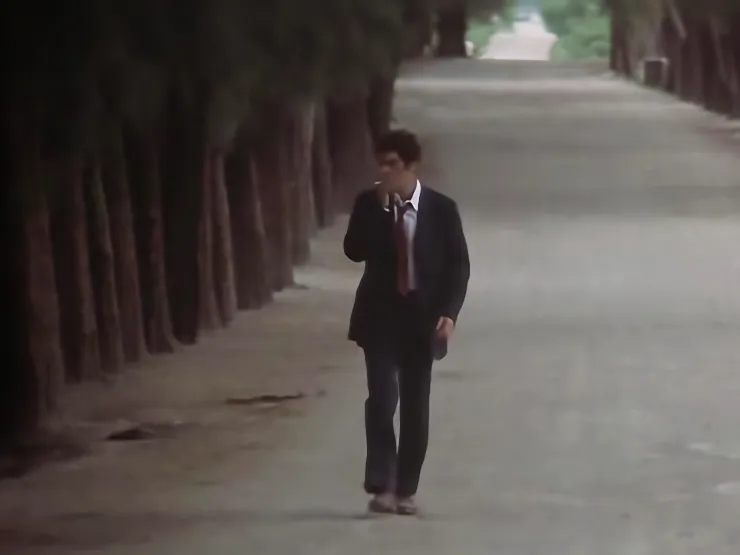
The Long Goodbye is exactly what the title suggests: a collage of metaphorical goodbyes, wrapped up in a detective story. Like Joel and Ethan Coen’s The Big Lebowski (1998), The Long Goodbye says farewell to the hippie dream. Like Billy Wilder’s tragic Sunset Boulevard (1950), it bids adieu to Classic Hollywood. Like Thomas Pynchon’s Inherent Vice (2009), it’s a coda for the hard-boiled detective novel, an antiquated relic that must be satirized in order to remain fresh and relevant. This is not Liam Neeson wearing a fedora. This is post-modernism. This is satire, executed by a masterful director, a complex re-imagining of a legendary character and his literary world.
That’s all for now.
See you in the movies,
Tod
© Copyright 2026 Debtford Press. All rights reserved.


