King of New York (1990): From My Cold Dead Hands
With no backstory or plot-related flashbacks, Frank White comes out of prison fully formed. This is a linear story, and we’re starting firmly in the middle.

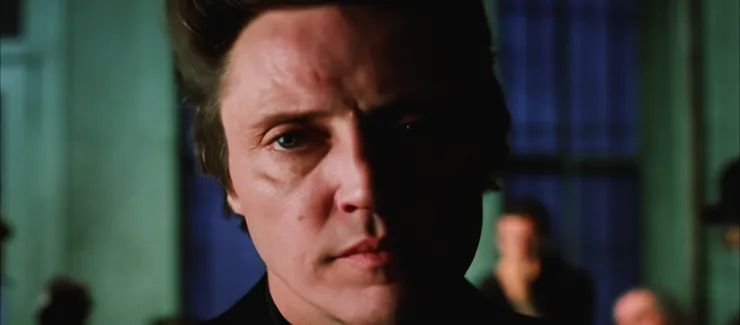
We open with interior shots of New York State’s infamous Sing Sing Prison. Frank White (Christopher Walken) is released from custody and climbs into a long black limousine parked outside the jail. As the car accelerates and the heavy iron gates swing shut, we know that however this story ends, it will not be with our protagonist going back to prison.
White’s limousine rolls along the Hudson river, heading for Manhattan. In the city, we cut to the targeted killing of a man inside a telephone booth. Before the assassins flee the scene, they place a newspaper on the victim’s bullet-ridden corpse. The camera zooms in on the front page and lingers there just long enough for us to read the headline: “Frank White Released From Prison.”
Violent, ominous, and yet still somehow stylishly understated, this sequence is King of New York at its Neo-Noir best.
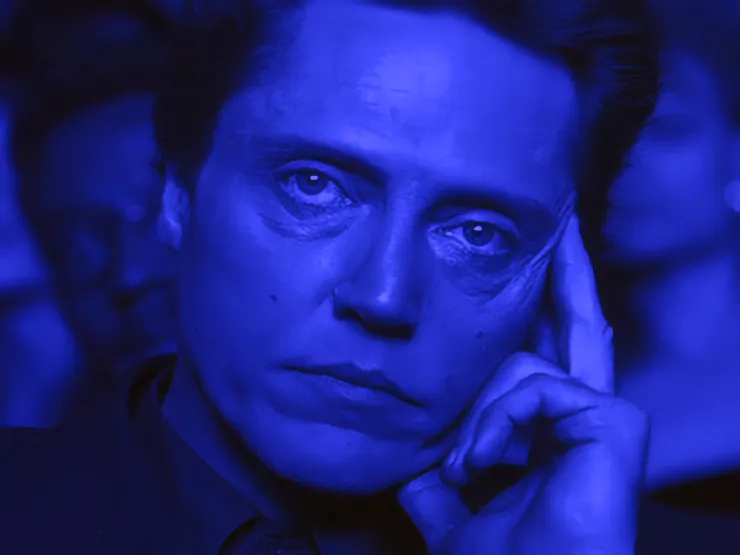
King of New York begins in medias res. With no backstory or plot-related flashbacks, Frank White comes out of prison fully formed. This is a linear story, and we’re starting firmly in the middle.
One thing Ferarra understands (that today’s filmmakers mostly don’t) is that in the context of THIS story, it doesn’t matter where Frank came from, or even how he got there. We learn everything we need to know by the actions of the people that surround him.
His women, his lieutenants, politicians, journalists, and the police: these characters act as walking, talking mirrors. Their demeanor reflects White’s status within the world of the film— without wasting our time by telling us about it.
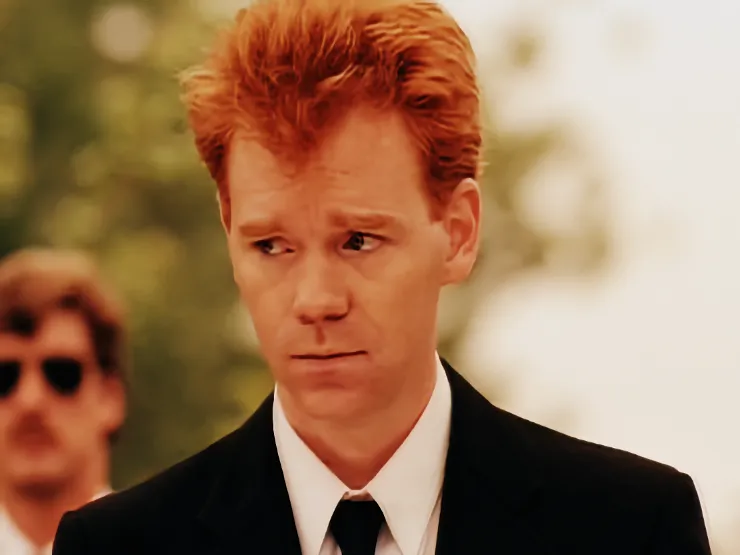
Once the setting, tone, and temporality have been introduced, the first act focuses on opening narrative loops and establishing the stakes.
We learn that prison has not softened Frank’s ambition or quelled his penchant for brutality. He intends on consolidating power in the New York City underworld, confirmed when he murders a rival crime boss at point blank range. But Frank’s motivations don’t emanate entirely from a place of selfishness. His concern about a local hospital is the first of many philanthropic missions in the film.
We also learn that despite a pair of gun-toting, lingerie ensconced women that seem permanently at his side, Frank’s romantic interests lie with Jennifer (Janet Julian), an up and coming lawyer in the District Attorney’s office.
Most importantly, we learn the cops want rid of Frank—by any means necessary. If that means an extra-judicial assassination, so be it.
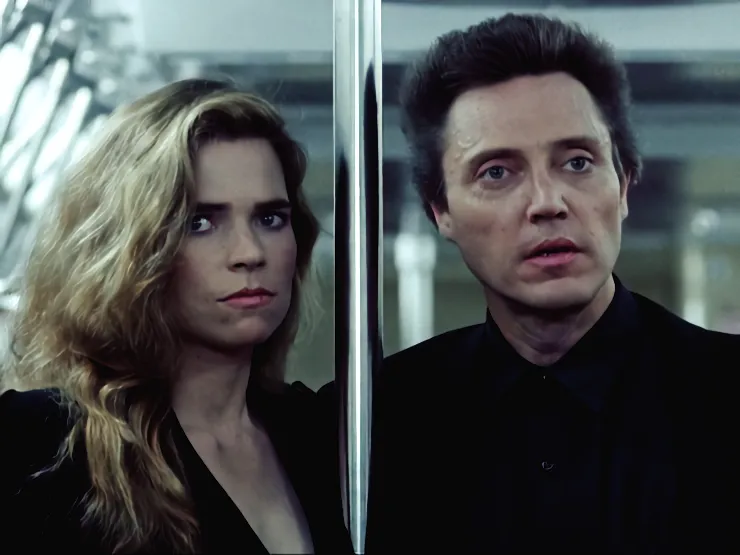
My favourite scene occurs on board a New York City subway car. Like the Broadway show, and the taxi scene that ends the film, the subway scene exemplifies the “show don’t tell” storytelling maxim.
Shortly after White’s release, Frank tells Jennifer he wants to “ride the subway." What follows is a raunchy make-out scene in which he fondles her exposed breast in the middle of an empty subway car—until they’re approached by a menacing trio. The youths reveal a knife, demanding jewellery and cash. But White stays completely calm, cooly opening his suit jacket to reveal a chrome plated handgun shoved into the waistband of his pants. As the boys retreat in fear, White tells them to stop, tossing them a money clip and suggesting they should work for him. No scene in King of New York exemplifies its title more than this one.
The subway scene reminds me of a similar instance in Money, the acclaimed 1984 novel by Martin Amis. On a business trip to New York City, the novel’s protagonist, John Self, is driven to a low-income neighbourhood by Fielding Goodman, his wealthy associate. Fielding insists they tour the block on foot as his limousine rolls along beside them. It’s not long until a group of locals approach, many of whom are holding weapons. Although Self is frightened, Fielding stays completely calm. Consider this passage:
“I suppose I understood. The Autocrat, the chauffeur, the bodyguard: this showed them the gulf, the magical distance. How did Fielding’s gesture go? One palm arched on the heart, the other turned in polite introduction towards the car, saying, ‘This is money. Have you all met?’ Then the hands brought together, face up, an offering of the simple proof. And they backed off in that stumbling, hurried, slightly reckless way that traffic pulls over for ambulances or royalty.”
Beyond their settings, what these scenes have in common is their ability to re-contextualize the message of their respective stories. In other words, both scenes raise a simple but important question: “Who, or what, is really in control of New York City?”
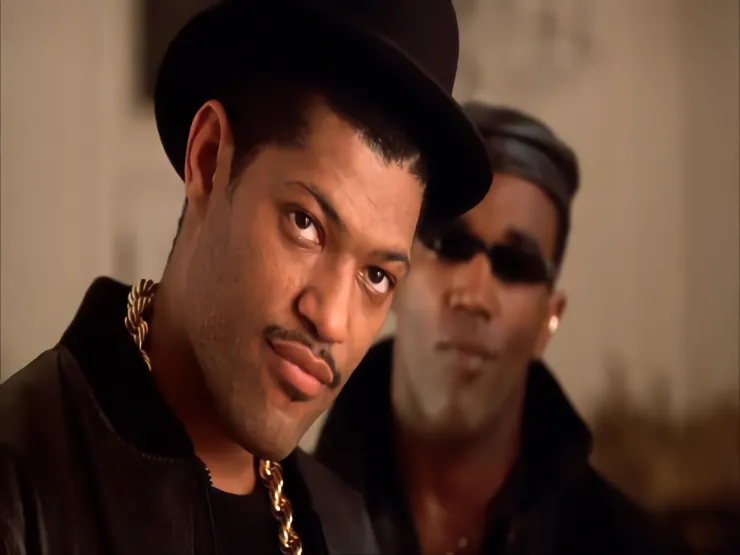
While critics of the day panned King of New York for things like graphic violence, racial stereotypes, and gratuitous sexual content, my personal criticisms are as follows:
- Frank White’s henchmen seem cartoonish: if not a cliche by 1991 standards, then certainly by today’s.
- The Act Two gun-fight-car-chase in the rain, though reminiscent of both Scarface and The Public Enemy, is too long, too wet, and way too dark. I don’t mean dark in a metaphorical sense. I mean that I couldn’t see what the fuck was going on. There’s also something vaguely “Bruce Willis” about the rain soaked fight scene. Not only are these cops acting as extra-judicial vigilantes, they’re working without warrants, SWAT trained officers, or any kind of back-up. Also, Wesley Snipes is wearing what appears to be a velvet beret. Seriously?
- The absurdity continues when Snipes gets shot five times at point blank range, but somehow manages to keep on fighting. Moments later, David Caruso executes Laurence Fishburne with a bullet to the head. My issue isn’t with this type of scene. My issue is that it happened in THIS movie. Scenes like this have no place in Film Noir. Nor do these types of cops. I felt like I was watching Colors (1988), or some other bullshit cop movie that doesn’t seem to know that it's a bullshit cop movie.
- King of New York also lacks a well-defined antagonist. There’s no Kristo (Night and The City), there’s no Leo (Thief), and there’s certainly no Harry Lime (The Third Man).
- Unlike its Film Noir Gangster Movie predecessors, King of New York also lacks any interpersonal conflict. Nobody challenges Frank White’s leadership, no one tries to steal his girl, no one in his inner circle betrays him. White’s only real relationship is with the city of New York—and sadly this idea is not fully explored.
- The film’s most interesting character is Jennifer, White’s lawyer. Is she in love with him, or just infatuated? Is she under his spell, or is she acting of her own free will? And if being with him truly is her choice, why would a successful young woman risk her entire future to associate with the likes of Frank White?None of the above is remotely explained, and that’s a shame. In fact, if King of New York was told from Jennifer’s perspective, it would have been a better film.
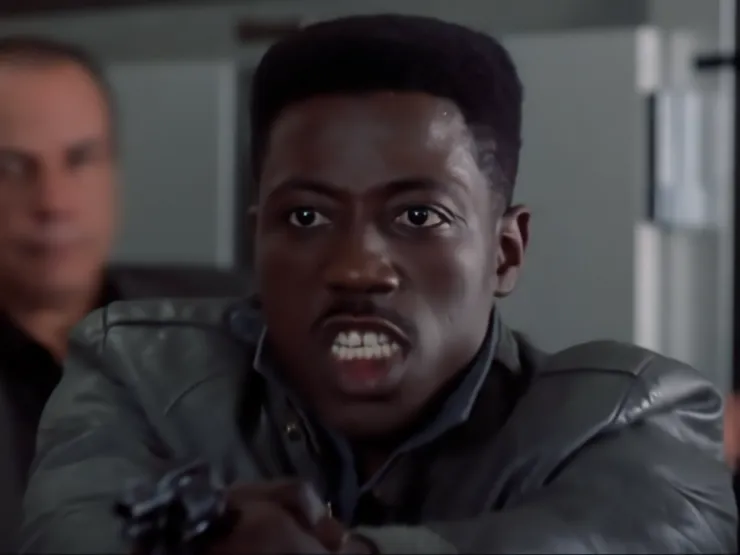
Like the aforementioned Martin Amis novel, King of New York’s most obvious subtext is its critique of late-stage capitalism. For viewers who may doubt the legitimacy of such a reading, keep in mind the film’s release coincided with one of America’s worst ever recessions.
Crucially, King of New York does not invoke Left/Right politics, nor does it suggest an alternative economic system. The film simply implies that market capitalism is not a self-correcting system: although it generates massive wealth, it does not evenly distribute that wealth, or guarantee equitable participation in capital markets. In other words, through Frank White, its murdering-drug-dealing-racketeering-gangster-turned-philanthropist, King of New York provides us with a basic maxim: you can’t fix what’s wrong with capitalism with even more capitalism.
Beyond this socio-economic reading, King of New York is also a film concerned with legacy. What do we leave behind? How will we be remembered? What will we be remembered for? Very rich men—fictitious or otherwise—seem especially fixated on these types of questions.
In terms of our protagonist, Frank’s obsession with his legacy stems from two complimentary motivations: he wants his earthly transgressions to MEAN something, and, he is childless. Frank White has no heirs. The business that he runs is also totally illegal, so the kinds of succession plans we see in the corporate world don’t really suit him either. In short, the only legacy he can really leave behind are the philanthropic endowments that can be bought with his illicit money.
In this respect, King of New York’s Frank White seems to have much in common with France’s ‘Sun King,’ Louis The Fourteenth. At the height of Louis XIV’s power, roughly 1670-1700, France was the predominant military force in Europe. Louis XIV also famously consolidated domestic power by bringing France’s bureaucratic and military aristocracies to heel under a variety of different strategies, some of which were generous and some of which were punitive.
Like Frank White, Louis XIV outlived his direct heirs. Without a credible successor, his death posed tremendous risks to both his legacy as King, and the stability of the country he had ruled for over seventy years. Consider these words, spoken to his grandson from his deathbed:
“Do not follow the bad example which I have set you; I have often undertaken war too lightly and have sustained it for vanity. Do not imitate me, but be a peaceful prince, and may you apply yourself principally to the alleviation of the burdens of your subjects.”
Ultimately, the key to understanding King of New York lies within the movie’s title. Who’s really in charge of New York City? It’s not the citizens. It’s not the politicians. It’s not the police. It’s not even Frank White. Money runs the city. Money is the real King of New York.
That’s all for now.
See you in the movies,
Tod.
© Copyright 2026 by Debtford Press. All Rights Reserved.