City Streets (1931): Gangster Cowboy Noir

Although charming and surprisingly modern, City Streets is best consumed as an artifact of movie making.

City Streets (1931): Gangster Cowboy Noir

Although charming and surprisingly modern, City Streets is best consumed as an artifact of movie making.

As a pre-code film, we get a glimpse of where cinema was going prior to succumbing to censorious government overreach in 1934. The way it blends together different genres without losing its Gangster Movie aesthetic tells us artistic expression was thriving during this brief but exciting era.

At the same time, one can argue City Streets also qualifies as an Early Noir or Pre-Noir film. The fact that Dashiell Hammett came up with the story is really all you need to know.
While “The Kid” is the kind of name more commonly associated with Westerns, the unnamed or nicknamed protagonist is absolutely a Film Noir attribute.

“Kid” is thus a forerunner to character names like “Driver” in James Sallis’s Drive (2005), Frank in Michael Mann’s Thief, the unnamed protagonist of Chuck Palahniuk’s Fight Club (1996), and of course, the narrator of the Daphne du Maurier classic, Rebecca (1938).

Gary Cooper as “The Kid."

Despite its influence on subsequent films, I disagree with the notion that City Streets is somehow similar to The Maltese Falcon.

Critics have a lazy habit of confusing Dashiell Hammett’s Sam Spade with Raymond Chandler’s Philip Marlowe, likely because Humphrey Bogart portrayed both characters throughout his long career. It’s also clear the aforementioned critics haven’t read the books those films were based upon.

While he’s a violent drunk who often bends the rules, Marlowe adheres to a personal code that remains consistent throughout his various adventures. He values truth above profit, often refusing his fee. He has a number of deep friendships that are explored throughout the series, policemen and scoundrels alike. His dalliances with women are brief, respectful and reluctant.

Spade, on the other hand, is arguably the villain of The Maltese Falcon. He’s sleeping with his partner’s wife right up until the day the man is murdered. His primary motivation is to retrieve the titular falcon so he can keep it for himself. His physical appearance is often compared to that of Satan. He lacks Marlowe’s sense of humor and sense of common decency. He hates the police and considers them his adversaries.

The reality is that beyond their profession, Sam Spade and Philip Marlowe have little in common. Critics who insist that City Streets and The Maltese Falcon are somehow cinematic cousins have thus succumbed to a similar mistake.

The world of The Maltese Falcon is a snake pit. Desperate and dreary, its cast of characters are devoid of any redeeming qualities. Although City Streets contains a Film Noir sensibility, those accents do not evolve into a full-blown world. Gary Cooper’s portrayal of The Kid has nothing in common with Humphrey Bogart’s Sam Spade. The Kid is capable of love. Sam Spade is not.

Legendary director Rouben Mamoulian.

Behind the lens of City Streets, Director Rouben Mamoulian was absolutely ahead of his time. Consider the following:

  • The quick tight shots of each gangster’s face in the moments after Blackie’s murder could easily appear in a Guy Ritchie’s Snatch (2000) or Quentin Tarantino’s Reservoir Dogs (1992).
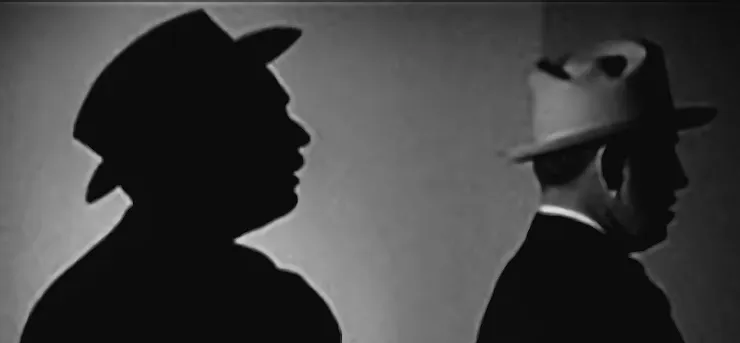
  • R.Z.’s hat drifting down the river of beer is quite similar to the expressionistic scenes that represent little Elsie Beckmann’s murder in the first act of Fritz Lang’s M. The same can be said for the seasons changing behind Nan’s jail cell window.
  • The exciting driving sequence in the final scenes of City Streets would be at home in an Alfred Hitchcock thriller or perhaps an action movie starring Steve McQueen.
  • Understated symbolism, like the cat statuettes in Aggie’s room, Kid’s white hat, or the hall of mirrors at the circus, should not go unappreciated.
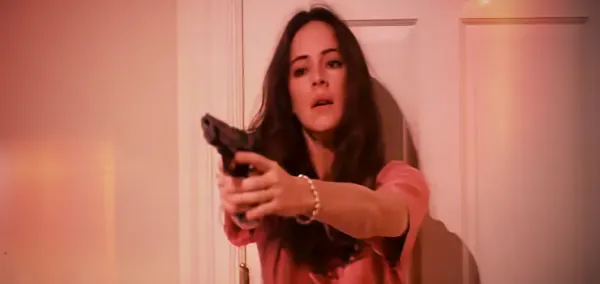
  • Aggie’s eyes between the doors, just before she pulls the trigger, should have been remembered as one of Film Noir’s most iconic shots—but City Streets came out a DECADE before the start of the Classic Film Noir period!
  • Perhaps most importantly, in City Streets, every murder happens off camera. This was not the result of censorship, nor was it because of any code. This restraint proves Mamoulian understood one of cinema’s most important maxims: the audience’s imagination is far more powerful than any moving image.
Gary Cooper as “The Kid."

City Streets’ status as an Early Noir Film comes down to more than just aesthetics. Its first half tells a story that could absolutely hold its own with those released fifteen years later.

The Kid doesn’t join the mob because he covets wealth or power. He’s duped into the decision on account of his concern for Nan, as well as his belief that she prefers to marry someone rich.

In this respect, Kid’s story is consistent with those of characters like Graham Greene’s Holley Martins (The Third Man, 1949) or Joseph Mankiewicz’s George Taylor (Somewhere In The Night, 1946), men who are drawn into a criminal underworld through no fault of their own.

Nan Cooley is a prototypical Femme Fatale, with a complexity that many female characters lacked in subsequent decades. In the film’s first half, she’s an enthusiastic participant in her stepfather’s beer racket, with no plans of going straight. After her incarceration, a wiser Nan is willing to do whatever it takes to escape the mob’s grip, even if that means murder. In this respect, her character arc is not dissimilar from that of Lily Powers in Baby Face (1933).

City Streets conveniently resolves itself without Nan (or Kid) killing anybody. While that narrative decision is most certainly vulnerable to criticism, the Film Noir characteristics of the first two acts are unassailable.

Unfortunately, the final act veers wildly off course: the moment Big Fella makes a move on Nan, City Streets becomes a Western. The rivalry between Big Fella and The Kid invokes a standard Western trope: “this town ain’t big enough for the both of us.”

Kid is the good guy. Big Fella is the bad guy. Kid is virtuous. Big Fella is lecherous. Kid wears a white hat. Big Fella wears a black one.

You get the idea.

As he escorts Nan home from her contentious party, Kid declares the only solution to their problem is a “showdown” with Meskal, an obvious allusion to the standard Western shoot-out trope. As the film concludes, Kid and Nan even ride off into the sunset together, albeit in a car instead of on a horse. In other words, what begins as an Early Noir gangster story becomes a Cowboy Western Romance.

Gary Cooper made a name for himself with roles in Western films. The great depression was also re-organizing the country’s geography, an on-going mass migration that re-popularized old ideas about America’s Western Frontier. Perhaps leaning into Cooper’s cinematic cowboy status was an attractive proposition for the studio.

Whether or not this Western shift works within the context of the film is not for me to say, but it’s clear that any notion of City Streets as a fulsome Early Noir evaporates in this strange third act.

A more interesting (and more Film Noir) resolution would have been if Nan had murdered Big Fella and The Kid had somehow accepted the blame, sacrificing their relationship to guarantee her future safety. Another option would have been if one of them had died to save the other.

With very few exceptions, a story that ends in marriage, actual or implied, is a comedy. While City Streets is more than worthy of your time—it’s simply not quite Noir enough to transcend beyond its status as a Gangster Movie artifact.

Sylvia Sidney as Nan Cooley.

By today’s standards, certain viewers might label City Streets as sexist or misogynistic in its portrayal of women. But sanctimoniously identifying the politically incorrect components of ninety year old films doesn’t qualify as criticism—at least not for those of us with brains.

In fact, a close reading of City Streets reveals an incredibly progressive film, in which female characters are the sole drivers of the plot:

  • Nan pushes Kid to join the mob. She sets the conditions that govern their relationship, not him.
  • Aggie facilitates her husband’s murder, acting in her own interest to elevate her social standing.
  • Nan chooses to take the rap for Pop and go to prison. Despite her eventual regrets, it’s not evident that she was initially coerced into doing so.
  • Jealous and betrayed, Aggie flat out murders Big Fella—and almost gets away with it.
  • It’s Nan who brings the gun to Big Fella’s house. Although she doesn’t pull the trigger, without Nan bravely taking action, he might have lived.
  • Protecting Nan is what lands Kid behind the wheel of the car that eventually becomes their getaway vehicle.

In short, there’s no City Streets without Nan and Aggie. Not only are they the film’s most interesting characters, their presence also highlights the mundane nature of their male counterparts. Kid is a dorky rube, a total bore until the last ten minutes of the film. Pop Cooley is a disgusting pig. Big Fella Meskal may be ruthless in theory, but our experience of him as viewers is more akin to that of watching a creepy waiter or a horny cartoon skunk.

Not unlike the film noir era that it influenced, in City Streets, only women make the movie work.

A decidedly ‘Film Noir’ shot—in 1931.

My take on City Streets is that it functions as a strange rendition of the American Dream. I don’t mean our consumer-driven conception of the idea: two cars, a house, two kids, a dog, a backyard pool and an annual vacation. I’m talking about the philosophical basis of the American Dream, the idea that in America you can choose who you want to be and then go off and become that person.

The Kid starts out as a wannabe cowboy working at a circus. In today’s nomenclature, he’s a “carny.” But by time we reach the second act, he’s become a rich gangster. He wears fur coats and drives expensive cars. He lives above the law. Later, he becomes the mob’s ultimate leader simply by making a verbal announcement! In the end, Kid drives off into the sunset with a beautiful young woman, presumably to get married and start again somewhere new.

Kid’s story contains examples of upward mobility, freedom of movement, business dynamism, economic opportunity, and social openness. Citizens can pick up and move to a new place without fear of local prejudice or legal repercussions. In America, anyone can make their dreams come true—even folks who’ve made mistakes.

Although its Western vibes don’t fit with the first hour of the film, this freewheeling ending is well suited to the year of its release.

1931 was a year in which the upheaval of the Great Depression was changing people’s ideas about how and where to live their lives, a year in which many Americans hit the road seeking better opportunities in other States.

As the car accelerates and the credits roll, we almost expect Kid to throw his cowboy hat into the sun.

© Copyright Debtford Press, 2026.